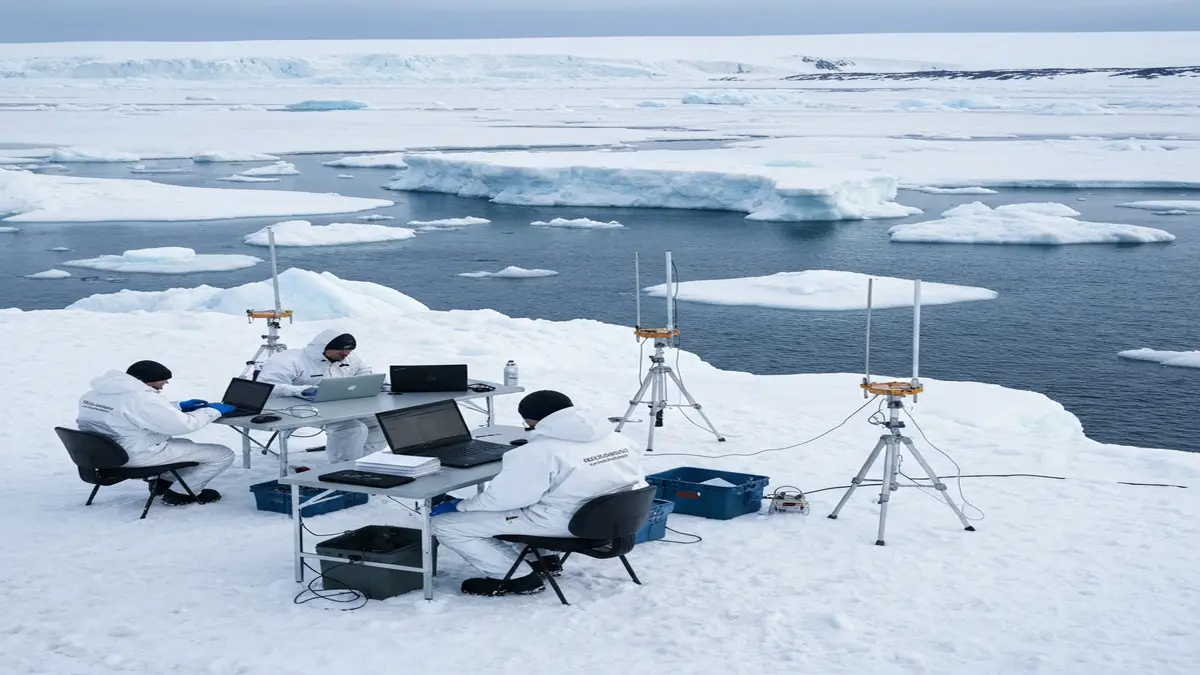
WASHINGTON – The Arctic Ocean’s vital sea ice cover reached its annual maximum extent on March 15, 2026, at a record low of 14.29 million square kilometers, statistically tying with 2025 for the smallest winter maximum in the 48-year satellite record. This alarming benchmark, announced by the National Snow and Ice Data Center (NSIDC) and NASA's Earth Observatory, signifies a loss of approximately 1.36 million square kilometers compared to the 1981-2010 average, an area equivalent to twice the size of Texas. Scientists also noted significantly thinner ice, particularly in the Barents Sea northeast of Greenland, contributing to what Dr. Zack Labe, a climate scientist at Climate Central, described as a "very alarming" winter for Arctic sea ice. "Arctic sea ice is entering late winter in one of its weakest states in the satellite record," Labe stated.
Globally, 2025 continued an unprecedented streak of warming, solidifying its place as one of the three warmest years on record. Multiple international datasets, including analyses from Berkeley Earth, the World Meteorological Organization (WMO), and the Met Office, consistently placed 2025 with an average global temperature exceeding 1.4°C above the 1850-1900 pre-industrial baseline. The WMO confirmed that the past 11 years, from 2015 to 2025, collectively represent the warmest 11-year period in recorded history. Crucially, the three-year average global temperature from 2023-2025 has for the first time surpassed the critical 1.5°C warming threshold, reaching 1.52°C according to data from the Copernicus Climate Change Service (C3S). This occurred despite the cooling influence of a La Niña event during parts of 2025, underscoring the relentless human-induced warming trend, as WMO Secretary-General Celeste Saulo highlighted.
The ramifications of sustained high temperatures are already evident. March 2026 witnessed an unprecedented surge in heat records across vast regions, including the United States, Mexico, Australia, Northern Africa, and parts of Northern Europe. Climatologist and weather historian Maximiliano Herrera characterized this as "by far the most extreme heat event in world climatic history". The accelerating melt of the Greenland ice sheet further compounds concerns, with extreme melting events increasing in frequency and intensity. Since 1990, the area affected by these events has expanded by approximately 2.8 million square kilometers per decade, and meltwater production has dramatically risen from 12.7 gigatons per decade (1950-2023) to 82.4 gigatons per decade in recent years.
Adding to the urgency, new research published in *Nature* on March 4, 2026, revealed that current global coastal sea levels are, on average, approximately one foot higher than previously assumed. This study, which analyzed 385 peer-reviewed studies, identified discrepancies of up to three feet in regions like Southeast Asia and the Pacific. Philip Minderhoud, a co-author of the study, warned that "if sea level in reality is higher for your particular island or coastal city than was previously assumed, the impacts from sea-level rise will happen sooner than projected". These revised baseline figures suggest that if sea levels rise by about three feet by 2100, between 77 million and 132 million more people globally could face inundation than earlier assessments indicated.
The pace of sea level rise is also accelerating. In the United States, sea level has risen 66% faster in the last five years compared to the historical rate, now increasing by an average of one inch every five years. An unexpected surge in 2024, observed by NASA, saw global sea levels climb by 0.23 inches, exceeding projections. This increase was notably driven more by thermal expansion—the physical expansion of warming ocean waters—than by melting ice, indicating a significant shift in ocean dynamics. The Intergovernmental Panel on Climate Change (IPCC) Sixth Assessment Report (AR6) already projects that under even low greenhouse gas emissions, global mean sea level could rise at least 0.3 meters (one foot) above 2000 levels by 2100. High emissions scenarios could see increases of up to 2 meters (6.6 feet) by 2100 and 3.9 meters (13 feet) by 2150 for the contiguous U.S..
Looking ahead, the scientific community anticipates continued challenges. While 2026 may see global temperatures similar to or slightly cooler than 2025 due to an ongoing La Niña, the broader trend remains upward. Columbia University scientists project a potential "super El Niño" developing later in 2026, which could lead to a new global temperature record of +1.7°C in 2027, further confirming an accelerated rate of warming. The confluence of rapidly disappearing Arctic ice, persistently high global temperatures, and higher-than-anticipated sea levels underscores the urgent need for more robust climate mitigation and adaptation strategies worldwide. As Professor Gail Whiteman, Executive Director of Arctic Basecamp, stated, "Arctic sea ice is a simple and visible barometer of climate change. Significant change in the Arctic is a particularly large global risk because the Arctic has a fundamental impact on our planetary operating system – what happens in the Arctic will affect all of us".